Author: May Moe Thu – Myanmar – PROMPT! Cohort #1
Introduction
In this article, I’ll be talking about CADASIL— a rare autosomal dominant disorder (If one copy of your NOTCH3 gene is mutated, it’s enough to cause CADASIL) that messes with the brain, often in people who are way too young to be dealing with strokes and memory loss.
CADASIL stands for Cerebral Autosomal Dominant Arteriopathy with Subcortical Infarcts and Leukoencephalopathy, yes, it’s a very long name. Most people haven’t even heard of CADASIL, but it’s real.So let’s break it down: what it is, how it works, and why it deserves way more attention than it gets. (NINDS)
To put it simply: if you’ve got the “glitched” NOTCH3 gene, your brain’s small blood vessels start breaking down over time, blocking blood flow to the brain.
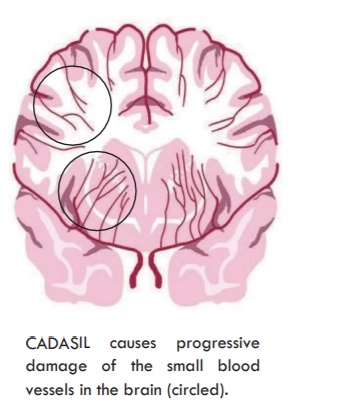
Figure 1. This picture shows the area of where the small blood vessels in the brain are damaged and where CADASIL occurs. (Cambridge Hospitals)
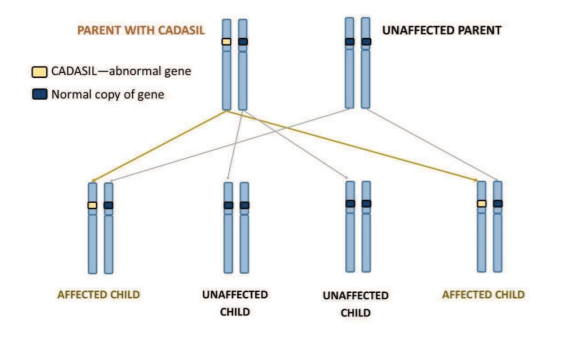
Figure 2. This is a diagram of how EASILY CADASIL can be inherited. As you can see, you need only one abnormal copy of the gene to be affected. (Cambridge Hospitals)
What causes these glitches?
This gene normally helps make a protein that keeps your brain’s tiny blood vessels working properly. But when there’s a mutation (or a glitch) in NOTCH3, the protein doesn’t work right.
Consequently, the broken protein builds up in the wall of the blood vessels, especially the ones in the brain. Over time, the buildup damages the vessels, making it harder for blood to reach parts of the brain. (Sakiyama et al.)
What do these patients with CADASIL deal with?
Most symptoms experienced are recurring strokes (even in their 20s or 30s), progressive cognitive decline, dementia, psychiatric issues, and migraine headaches, often with visual or sensory disturbances in which they are called “aura”. There are also less experienced symptoms, such as: seizures, vision problems, slow movement and tremors (like that of Parkinson’s), numbness, nausea, and so on. Fortunately, symptoms progress slowly. However, most patients with CADASIL develop cognitive impairment or dementia. (NINDS)
Why is it so easily misdiagnosed?
Many people are told it’s just “migraines” or stress. It’s also often confused with MS (multiple sclerosis, a neurological disorder where myelin is destroyed), Alzheimer’s, or psychiatric symptoms. Note that it is also easily overlooked because it is unusual for young people to have strokes. (Johns Hopkins)
What makes people misdiagnose CADASIL with MS?
On MRI scans, white lesions (spots) in the brain are shown. However, lesions are especially near the front of the brain in CADASIL while they are near the center of the brain in MS. Both patients of CADASIL and MS experience memory, psychiatric, and vision problems (there are many other shared symptoms as well). Doctors can differentiate CADASIL and MS by DNA testing or looking at the spinal fluid and immune markers (as MS is autoimmune while CADASIL is genetic). (Gazda)
Figure 3. Cureus – CADASIL in a 32-Year-Old Male Presenting with a Transient Ischemic Attack. View the case report and image
What are actual ways to diagnose CADASIL?
The most common methods are genetic testing and skin biopsy. Genetic testing is carried out by taking a blood test of a person’s DNA to look for any mutation in the NOTCH3 gene. As for skin biopsy, CADASIL doesn’t just affect the brain, it can also change tiny blood vessels in your skin. Doctors can take a small sample of skin and look at it under a microscope to spot these changes. Doctors can also diagnose CADASIL by examining a patient’s symptoms, family history, and brain MRI. (NINDS)
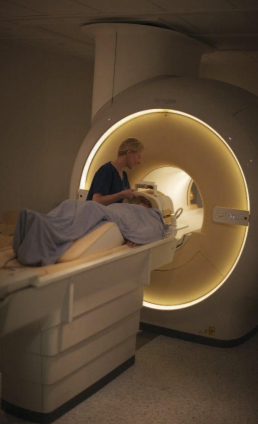
Figure 4. This is an MRI machine, it does not involve radiation but it can be distressing for claustrophobic people. (Cambridge Hospitals)

Figure 5. Blood sample being prepared for genetic testing. (Main Line Health)
What treatments are there?
Unfortunately, no cure has been found for CADASIL, but its symptoms can be managed. For example, migraine attacks can be managed by taking conventional migraine medications. Likewise, anti-seizure medications can be used to help control epilepsy, while aspirin or clopidogrel can be used to reduce the risk of stroke. In addition, medications and therapy can help treat depression, while cognitive therapy (such as mental exercises) can address memory loss. (Butler Hospital)
Why CADASIL needs more attention
CADASIL is extremely rare, but that doesn’t mean it’s not important. It’s often misdiagnosed, misunderstood, and overlooked (even though it can lead to strokes, memory loss, and other serious problems). Because it’s genetic, it can affect entire families, and right now, there’s no cure. That’s why raising awareness matters. The more people know about CADASIL, the more likely we are to get better research, earlier diagnoses, and maybe even future treatments. Every voice counts, especially yours.
References (MLA 9)
- CADASIL. National Institute of Neurological Disorders and Stroke, n.d., https://www.ninds.nih.gov/health-information/disorders/cadasil..
- CADASIL – A Guide for Patients and Families. Cambridge University Hospitals, n.d., https://www.cuh.nhs.uk/patient-information/cadasil-a-guide-for-patients-and-families/..
- Khan, M. A., et al. “Cerebral Autosomal Dominant Arteriopathy with Subcortical Infarcts and Leukoencephalopathy (CADASIL) in a 32-Year-Old Male Presenting with a Transient Ischemic Attack (TIA).” Cureus, vol. 15, no. 7, 2023, p. e217582, https://doi.org/10.7759/cureus.217582..
- Sakiyama, Y., et al. “Peripheral Neuropathy in a Case with CADASIL: A Case Report.” BMC Neurology, vol. 18, no. 1, 2018, https://doi.org/10.1186/s12883-018-1131-3..
- CADASIL vs. Multiple Sclerosis: Is It Misdiagnosis or Concomitant? A Case Series. Johns Hopkins University, n.d., https://pure.johnshopkins.edu/en/publications/cadasil-vs-multiple-sclerosis-is-it-misdiagnosis-or-concomitant-a..
- Multiple Sclerosis – Symptoms and Causes. Mayo Clinic, n.d., https://www.mayoclinic.org/diseases-conditions/multiple-sclerosis/symptoms-causes/syc-20350269..
- Gazda, Suzanne. “Is It MS or CADASIL? The Distinctions Affect the Diagnosis.” Suzanne Gazda M.D., n.d., https://www.suzannegazdamd.com/blog/is-it-ms-or-cadasil-the-distinctions-affect-the-diagnosis..
- CADASIL. Butler Hospital, n.d., https://www.butler.org/memory/cadasil/..
- Pecci, Allyson. “Fighting for Awareness, Answers, and a Cure to Rare Vascular Disease CADASIL.” Northshore Magazine, 26 Mar. 2024, https://www.nshoremag.com/faces-places/fighting-for-awareness-answers-and-a-cure-to-rare-vascular-disease-cadasil/..
- Blog – Pros and Cons of Genetic Testing. Main Line Health, 6 May 2019, https://www.mainlinehealth.org/blog/pros-and-cons-of-genetic-testing..