Author: Sara Aphrodite – Bangladesh – PROMPT! Cohort #1
A small nation in South Asia, Bangladesh. Surrounded mostly by India, Myanmar from the southwest and the Bay of Bengal from the South. Despite having economical downfalls and former difficulties Bangladesh is now called one of the fastest growing economies in the world. In this blog we will go through this rapid transformation and as there is always scope for development we will talk about the shortcomings of Bangladesh and ways to develop it, by utilizing the demographic trends of Bangladesh, and environmental and human factors that affect Bangladesh’s development.
According to the most recent census by World Bank (2024) Bangladesh has a population of 173.6 million.
Pre – Development phase
From March of 1971 to December 1971, Bangladesh fought a liberation war with Pakistan, in which after 9 months of fighting Bangladesh gained independence. Regardless of the encouraging news, Bangladesh had to face many unavoidable circumstances. One of the demographic factors of Bangladesh’s high population density and distribution is its low lying delta and tropical climate however every blessing comes with a burden, Bangladesh is also prone to natural disasters, like flooding, cyclones, river erosion. These affected the country largely post war. During this time Bangladesh faced famine and a great economic depression, there was a mass destruction and lost jobs along with lives. After the war there was poverty and a huge political turmoil. It was getting difficult day by day to establish a stable democratic government. If we look at the demographic transition model (DTM) , a model that explains how a country’s population changes over time. Bangladesh was in Stage 1 of the DTM where birth rates were high due to a high infant mortality rate so parents had kids ‘just in case’, education was extremely poor, and industrialisation didn’t take place, kids were used as labourers. Along with poor family planning, no access to contraceptive methods and social stigma. Death rates were high naturally as the country most recently went through a war along with poor healthcare. Healthcare and education, these basic factors weren’t given much attention as the government was trying to stabilise the devastation that was going on. The dependency ratio was imbalanced, there were too many children which required the government to take care of them, in terms of healthcare and education which in turn put pressure on the economy and resources. This was a demographic burden. This stage in the DTM can also be seen through Bangladesh’s population pyramid in 1971.
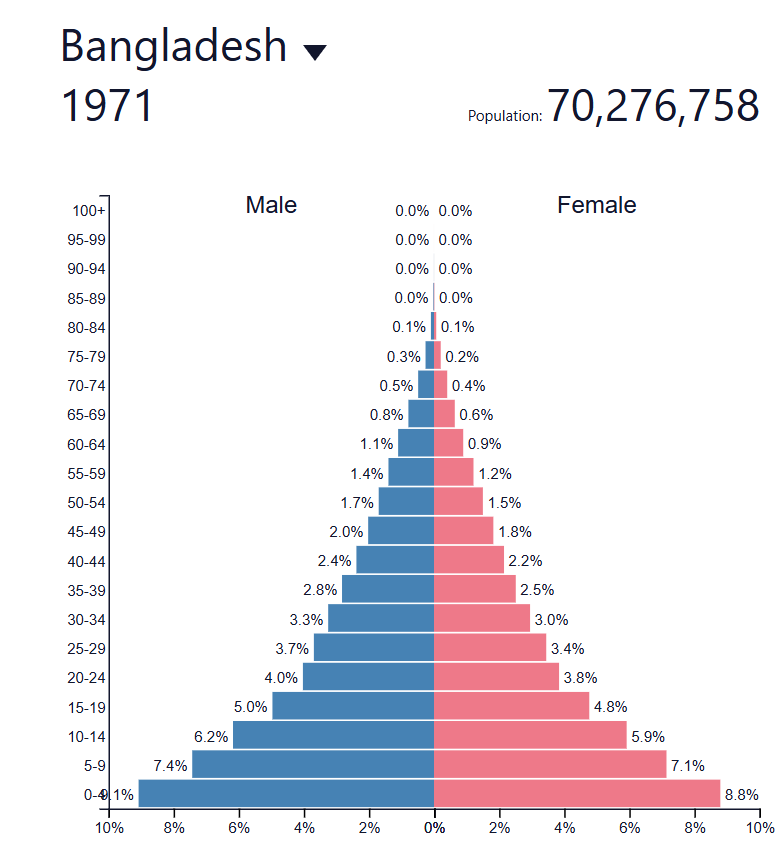
Figure 1: Population pyramid of Bangladesh in 1971 (PopulationPyramid.net, 1971)
As we can see, on the population pyramid of Bangladesh in 1971, there is a wide base which indicates a high birth rate while the top is very narrow and this shows a very low life expectancy. This structure of the pyramid is often seen in LEDC’s (less economically developed countries)
Transitional Period
From the end of 19th century to early 2000, Bangladesh went through a period of transition where, from being at around stage 1-2 of the DTM it started developing and going to stage 3, where birth rate falls rapidly and death rate is falling slowly. What changed?
Healthcare got significantly better in Bangladesh, vaccinations to prevent illnesses were given, which helped decrease child mortality rates and increase life expectancies. Medical services also were being developed, with better hygiene. Improvised food and water supply along with foreign aid was also there. During this time urbanisation happened, people were getting more modernised, therefore the societal customs and beliefs were changing and family planning progressed. Education for females was emphasized therefore, women started getting jobs, and early teen marriages decreased significantly which led to having less children, this is also a reason for a decrease in birth rates. NGOs like BRAC, Grameen Bank, worked for women empowerment and to reduce poverty. As the country got industrialised, materialistic needs increased while the need for having children decreased. This demographic shift can be seen very clearly, if we look at the population pyramid of Bangladesh in the 2000s compared to the one we have seen in 1971. On the population pyramid of 2000 the base is getting narrower compared to the one in 1971 this shows low birth rate and if you see the percentage of the people whose ages are 80-84 it is 0.1% which is 182,224 men whose ages are 80-84 and 160,126 women who are that age. This shows a higher life expectancy compared to the 1970’s, where, if you refer to the pyramid, only average 57,000 men and women lived up to the ages of 80-84
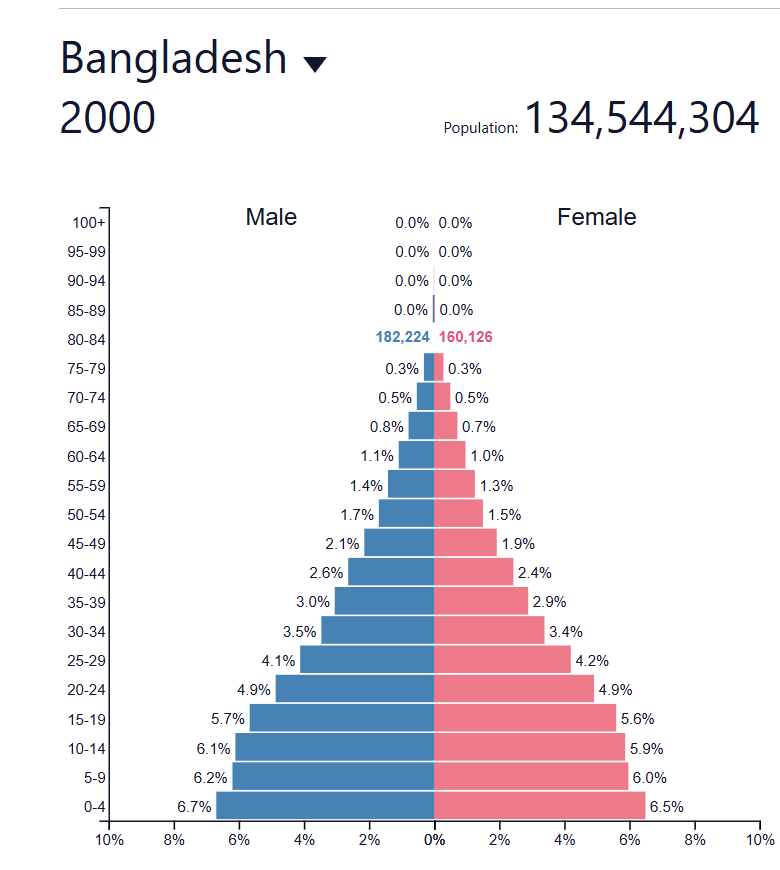
Figure 2: Population pyramid of Bangladesh in 2000 (PopulationPyramid.net, 2000)
Significant Growth and Improving Economy
From 2000 to 2020, Bangladesh faced a huge growth and a glow up in its economy, it went through a significant economic development, especially in the garment industry. Today if you go to any large brands like H&M, Zara and even Louis Vuitton, and look at the tags you can see it will say that the clothing is made in Bangladesh. Remittances from abroad also boosted Bangladesh’s economy, post war, as job opportunities were limited, people started migrating abroad especially to the Middle East. After earning they sent their earnings back to Bangladesh to their families, who used that money for better living conditions. This helped Bangladesh move to an upper stage in the DTM. Improvements in infrastructure like more bridges and roads took place. Actionable steps were taken to prevent natural disasters and NGOs were working to prevent poverty and to help people in the rural areas. If we refer to the DTM, Bangladesh was now in the late stage 3 and was approaching stage 4. In stage 4, both birth and death rates are stable, which indicates that a country has an acceptable amount of birth and death rates. For Bangladesh this highlights its development in various aspects, economically, and in providing a standard way of life for its population. Equality was now being greatly emphasized too, women now entered the workforce. Despite this development, Bangladesh faced great environmental issues, as Dhaka got more urbanised the atmosphere and air quality got more and more polluted. One of the other environmental factors of Bangladesh is that it is surrounded by many rivers and bodies of water, which is a good thing in terms of soil quality, vegetation and water supply, however every pro has its cons, this also caused river erosion, which resulted in the loss of homes for many people. Now, if we quickly refer to the population pyramid the base started to shrink and it started to get into a more rectangular balanced shape, with a slight bulge in the working age group. This period is called the Demographic Dividend.
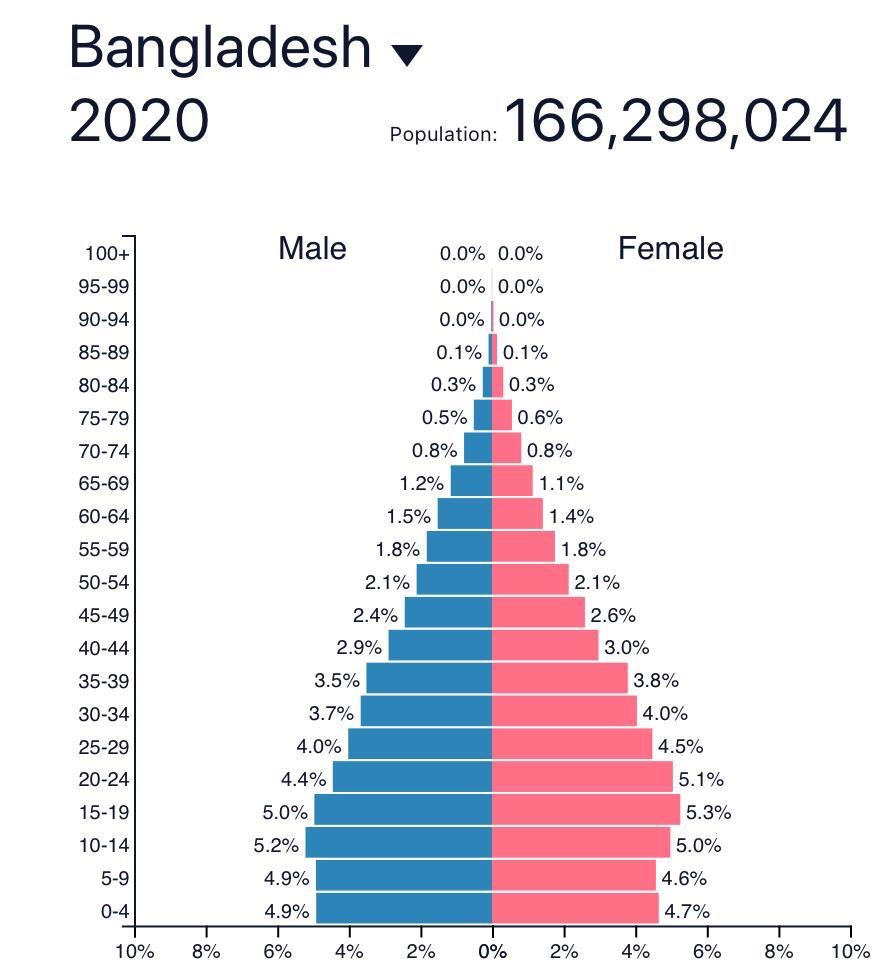
Figure 3: Population pyramid of Bangladesh in 2020 (PopulationPyramid.net, 2020)
Today and the Future of Bangladesh
Although Bangladesh has faced such amazing development it still has areas of improvement. It is now recognised as one of the fastest developing countries in the world. Bangladesh is now being technologically advanced more than ever. The youth of Bangladesh is taking steps in order to make it a better place for the future generation, However, climate change and natural disaster is becoming an obstacle, fortunately, adaptation strategies are being developed in order to mitigate it. Bangladesh is now in stage 4 of the DTM, the fertility rate is close to the replacement level (~2.0 births per woman). The replacement level is the birth that is required to exactly replace a couple in the population. Globally it is 2.1 births per woman. If Bangladesh’s fertility rate falls below the replacement level it can result in a shrinking population and eventually stage 5 of the DTM, where birth rates fall below death rates which – Natural Decrease. By 2050, it is predicted that Bangladesh will reach stage 5 which can result in having to invest too much on pensions and healthcare. The youthful population can be a demographic dividend if there are enough opportunities or a demographic burden if poverty and unemployment continue. Some of the future challenges are extreme urbanisation, pollution, natural disasters, and lack of job opportunities.
Finally, it can be summarised that a country with 54 years of independence, a country that once faced famine and was economically shattered is now developing at an extremely fast pace. It has achieved modernisation, economic development and major improvements in providing a standard of life. From stage 1 to now stage 4 of the DTM, it was quite a magnificent development. Physical factors like floodplains but also natural disasters were also there but Bangladesh didn’t step back, human factors like NGOs, remittances, and education have worked together to shape its development. This story is unique despite facing many challenges like natural disasters and limited resources, Bangladesh made great progress. In the future Bangladesh needs to focus on sustainability, innovation and job creation.
References —
- Waugh, D. The New Wider World. Chapter 1: Population, pp. 1–19. [Oxford University Press], [2009].
- PopulationPyramid.net. (1971). Population pyramid of Bangladesh 1971.
- PopulationPyramid.net. (2000). Population pyramid of Bangladesh 2000
- PopulationPyramid.net. (2020). Population pyramid of Bangladesh 2020